The Consequences of Menopause on Women’s Cognitive Functioning

Problem Statement

All women undergo the menopause transition. According to Mosconi et al, menopause is a “neuro-endocrinological process that impacts aging trajectories of multiple organ systems including the brain.”1 The authors describe how menopause is both a reproductive transition state and a neurological transition “as evidenced by the fact that many menopausal systems are neurological in nature such as hot flashes, disturbed sleep, mood changes, and forgetfulness.” Morgan and colleagues point to the ever-growing public health concern of cognitive decline and dementia.2 Specifically, the authors note, “evidence suggests that midlife may be a critical period in the natural course of dementia. For women, understanding the effects of reproductive aging on cognition in midlife and beyond remains a topic of great interest, particularly given that estrogens are involved in a number of cellular pathways that underlie brain function.” The authors also posit the idea that perimenopause may be a “therapeutic window” where hormone therapies could possibly prevent cognitive decline in a woman’s later adult life.

Reuben et al conclude that “subjective cognitive decline and the loss of ovarian hormones after menopause have been independently linked to later-life Alzheimer’s disease.”3 The authors discuss that several studies have found that “cognitive complaints increased across the menopause transition and were associated with reductions in attention, verbal and working memory… Women taking estrogen-decreasing treatments also had increased cognitive complaints and reduced working memory and executive function.”

Status of the Literature

All women undergo menopause, though the experience may happen in different ways: through the natural aging process, by the surgical removal of the ovaries, or as medically-induced menopause that occurs due to radiation therapy and/or chemotherapy. The most widely-believed classic symptoms of menopause are hot flashes and a decreased sex-drive. While these are prominent symptoms of menopause transition, they have become stereotypes that draw attention away from changes in women’s brains such as brain fog, lack of focus, and difficulty with word finding. In her 2019 TED talk, Lisa Mosconi notes that both a woman’s ovaries and her brain are connected through the neuroendocrine system, and that the “estrogen produced by the ovaries is critical to providing energy to the brain.”4

Other common symptoms related to estrogen loss result in mood disturbances. Depression and anxiety are more likely to occur after a woman has completed menopause. In their systemic review and meta-analysis, Georgakis et al found that “early menopause is a risk factor for depression in postmenopausal women.”5 A further finding is that “women’s age at menopause has been inversely associated with the risk of cardiovascular disease.” Women who experience menopause prematurely (<40 years of age) are 3 times more likely to develop multi-morbidity disease, including heart disease, in their 60s.

One of the most notable factors for post-menopausal women is an increased risk for developing dementia and Alzheimer’s disease. McCarrey and Resnick state that “observational results from longitudinal studies of surgical menopause indicate that both young and old women who have undergone bilateral oophorectomy carry an increased risk of cognitive impairment and dementia, as well as reductions in global cognition and memory.”6 While their study focuses mostly on the surgical initiation of menopause, they assume women who undergo menopause naturally will experience the same affects.

Call to Action

For social workers employed in the medical field, it is vital to know and understand how menopause is linked to dementia and Alzheimer’s disease. Part of a social worker’s responsibility is education. Social workers should educate others in the medical field, including other social workers as well as physical therapists, dieticians, etc, to not only increase their knowledge on the subject but to enable them to share this information with their patients. This knowledge has the potential to impact the lives of women by improving the quality of life in later years. It is evident in the medical literature that compared to men, women are at an increased risk of cognitive decline and dementia. Major stressful events have been associated with the onset of Alzheimer’s disease at a younger age, and women seem to have a more abrupt increase in cortisol levels after stress than men, which is even higher in older individuals. Also, “neuroinflammation, which is an emerging Alzheimer’s disease pathological feature, has been proposed as a potential mediator to the estrogen depletion effects on cognition” (Georgakis et al 2016). It is critical to know the many health risk factors that may influence the risk for dementia and Alzheimer’s disease. An individualized health risk assessment is necessary to determine a woman’s risk for cognitive decline in her later years. Based on this assessment, a woman may be a good candidate for menopausal hormone therapy, which could exert neuroprotective effects in the aging process, thus increasing her quality of life.

References

1. Mosconi L, Berti V, Dyke J, Schelbaum E, Jett S, Loughlin L, Jang G, Rahman A, Hristov H, Pahlajani S, Andrews R, Matthews D, Etingin O, Ganzer C, de Leon M, Isaacson R, Brinton RD. Menopause impacts human brain structure, connectivity, energy metabolism, and amyloid-beta deposition. Sci Rep. 2021 Jun 9;11(1):10867. doi:10.1038/s41598-021-90084-y.

2. Morgan KN, Derby CA, Gleason CE. Cognitive changes with reproductive aging, perimenopause, and menopause. Obstet Gynecol Clin North Am. 2018 Dec;45(4):751-763. doi:10.1016/j.ogc.2018.07.011.

3. Reuben R, Karkaby L, McNamee C, Phillips NA, Einstein G. Menopause and cognitive complaints: are ovarian hormones linked with subjective cognitive decline? Climacteric. 2021 Aug;24(4):321-332. doi:10.1080/13697137.2021.1892627.

4. Mosconi L. How menopause affects the brain. Presented at TEDWomen 2019: Bold + Brilliant, December 5, 2019. https://www.ted.com/talks/lisa_mosconi_how_menopause_affects_the_brain. Accessed November 21, 2022.

5. Georgakis MK, Kalogirou EI, Diamantaras AA, Daskalopoulou SS, Munro CA, Lyketsos CG, Skalkidou A, Petridou ET. Age at menopause and duration of reproductive period in association with dementia and cognitive function: A systematic review and meta-analysis. Psychoneuroendocrinology. 2016 Nov;73:224-243. doi: 10.1016/j.psyneuen.2016.08.003. Epub 2016 Aug 3. PMID: 27543884.

6. McCarrey AC, Resnick SM. Postmenopausal hormone therapy and cognition. Horm Behav. 2015 Aug;74:167-72. doi: 10.1016/j.yhbeh.2015.04.018. Epub 2015 Apr 30. PMID: 25935728; PMCID: PMC4573348.

Citation

Ewoniuk A. (2023). The Consequences of Menopause on Women’s Cognitive Functioning. Utah Women’s Health Review. doi: 10.26054/0d-6az8-42k4
PDF

View / download

Pregnancy & Opioid Addiction

Background

Opioid addiction during pregnancy can significantly impact the physical, mental, and overall wellbeing of women and their infants. During pregnancy and the post-partum period, women can be much more vulnerable to drug use, drug addiction relapse, and drug-induced mortality.1 Drug-induced death is the top cause of pregnancy-related death in Utah, with nearly 90 percent of pregnancy-related deaths occurring in the post-partum period and approximately 80 percent of these due to opioid use.1 Prescription opioids are the primary source of opioid use disorder in pregnant women.2 In analyses of Medicaid-enrolled women (2000-2007, 2008-2015), Utah repeatedly ranked in the highest category (by rate) of prescription opioid use among pregnant women in the United States.2,3 Given the persistent rates of opioid use among pregnant women in Utah, attention to the literature and to treatment gaps is warranted. 

For treatment of opioid use disorder (OUD), medication assisted therapy (MAT) is usually provided at centers with integrated behavioral therapy, consistent with published standards of care.4 The use of methadone, buprenorphine, or buprenorphine-naloxone in MAT during pregnancy are well supported in the literature.5,6 

Head-to-head comparisons of methadone and buprenorphine favor buprenorphine for various neonatal outcomes.7,8 There are no meta-analyses of these studies, nor studies in mother-newborn dyads, about long-term abstinence for any OUD treatment types including MAT. The assumption may be necessary that treatment modalities studied in the general population with OUD offer similar efficacy for pregnant women with OUD. Generally, MAT ranks highly in efficacy,9 as does residential treatment,10 on long-term abstinence from opioids. Unlike with alcohol treatment and continuing abstinence, there are no head-to-head reviews of MAT vs. fellowship-based programs, such as Alcoholics Anonymous (AA) or Narcotics Anonymous (NA), on long-term efficacy for treatment of OUD.11

Beyond literature gaps also lie care gaps. State-wide distribution of MAT providers is an issue. A survey by Ragsdale et al (2021) identified areas of significant concern, wherein the majority of pharmacies reported gaps in MAT access in their communities.12 Factors influencing these gaps included affordability of the medications and/or programs at MAT centers, distance to providers, shortage of providers and specialists, and lack of education and outreach.12 Prescriber-specific factors for offering MAT include costs associated with methadone and/or buprenorphine certifications (ie, time and money).13 Where MAT is offered outside of integrated treatment centers, additional factors arise, including risk of diversion and safety of personnel at distribution points, typically pharmacies or clinics.13

The Substance Abuse and Mental Health Services Administration (SAMHSA) currently lists 17 treatment centers for integrated MAT and behavioral therapy in Utah.15 We contacted each of these via phone in February 2022, and 95 percent offered services to pregnant women. Buprenorphine alone was favored for pregnant women by some programs. Of the 17 centers, some offered methadone only, and some centers also offered one or more of the medications that include buprenorphine.

Call to Action

We recommend further research in the following areas: literature review and meta-analyses of methadone vs. buprenorphine on short and long-term outcomes; long-term abstinence studies through the post-partum period and under consideration of residential programs and women-only community-based addiction recovery fellowship groups. Additionally, there are currently no studies on the barriers that Utah prescribers and pharmacies may experience for offering methadone or buprenorphine treatment.

At the point of care, Utah mandates priority access for pregnant women to general opioid treatment programs.14 However, state-level statutes, including in Utah, define opioid use during pregnancy (or maternal opioid positivity at birth) as child abuse, which poses significant barriers to women seeking treatment.14 Fear of related legal action may drive pregnant women away from seeking care and/or continued engagement in care.14 Revision of this statute is recommended. 

Accessibility to stand-alone prescribers also demonstrates gaps. In Utah, there are no MAT centers outside of Washington County and the Wasatch front.15 The Kem C. Gardner Policy Institute at the University of Utah identifies Central Utah, Weber-Morgan, and Tooele counties as top areas of concern.16 This is due to high rates of opioid-related deaths and low availability of MAT and other treatment options. Names of buprenorphine prescribers, by state and city, are freely available on the internet.17 Our own analysis of Utah prescribers identified the following central Utah counties of particular concern, due to persistent opioid mortality and zero availability of MAT prescribers: Duschene, Garfield, Grand, Iron, Kane, Piute, and San Pete counties.17,18 

In conclusion, we emphasize the need for studies in several Utah locations with a focus on overcoming MAT barriers, research on long-term abstinence in mother-newborns dyads, and statutory revision.

References

1. Smid MC, Stone N, Baksh L, Debbink MP, Einerson BD, Varner MW, et al. Pregnancy-associated death in Utah: contribution of drug-induced deaths. Obstet Gynecol. 2019 Jun;133(6):1131-40

2. Desai RJ, Hernandez-Diaz S, Bateman BT, Huybrechts KF. Increase in Prescription opioid use during pregnancy among Medicaid-enrolled women. Obstet Gynecol. 2014 May;123(5):997-1002-2

3. Straub L, Huybrechts KF, Hernandez-Diaz S, et al. Chronic prescription opioid use in pregnancy in the United States. Pharmacoepidemiol Drug Saf. 2021;30(4):504-513. doi:10.1002/pds.5194

4. University of Michigan Injury Prevention Center. Michigan safer opioid prescribing toolkit, 2021. Accessed March 1, 2022. https://injurycenter.umich.edu/opioid-overdose/michigan-safer-opioid-prescribing-toolkit/post-overdose-toolkit/mat/mat-resources/

5. Jones HE, Finnegan LP, Kaltenbach K. Methadone and buprenorphine for the management of opioid dependence in pregnancy. Drugs. 2012 Apr 1;72(6):747-57.

6. Substance Abuse and Mental Health Services Administration (SAMHSA). Clinical guidance for treating pregnant and parenting women with opioid use disorder and their infants. HHS Publication No. (SMA) 18-5054. Rockville, MD: 2018

7. Jones HE, Kaltenbach K, Heil SH, et al. Neonatal abstinence syndrome after methadone or buprenorphine exposure. N Engl J Med. 2010;363(24):2320-2331. doi:10.1056/NEJMoa1005359

8. Meyer MC, Johnston AM, Crocker AM, Heil SH. Methadone and buprenorphine for opioid dependence during pregnancy: a retrospective cohort study. J Addict Med. 2015;9(2):81-86. doi:10.1097/ADM.0000000000000092

9. Haffajee RL, Lin LA, Bohnert ASB, Goldstick JE. Characteristics of US counties with high opioid overdose mortality and low capacity to deliver medications for opioid use disorder. JAMA Netw Open. 2019;2(6):e196373. doi:10.1001/jamanetworkopen.2019.6373

10. Gray C, Argaez C. Residential Treatment for Substance Use Disorder: A Review of Clinical Effectiveness [Internet]. Ottawa (ON): Canadian Agency for Drugs and Technologies in Health; 2019 Jan 4. 

11. Erickson M. Alcoholics Anonymous most effective path to alcohol abstinence. Stanford Medicine News Mar 11, 2020. Accessed February 6, 2022. https://med.stanford.edu/news/all-news/2020/03/alcoholics-anonymous-most-effective-path-to-alcohol-abstinence.html 

12. Ragsdale RJ, Nickman NA, Slager S, Fox ER. A 2019 evaluation of opioid use disorder treatment resources in rural Utah counties. Journal of the American Pharmacists Association. 2021 Sep 1;61(5):513-21.

13. Andrilla CHA, Moore TE, Patterson DG. Overcoming barriers to prescribing buprenorphine for the treatment of opioid use disorder: Recommendations from rural physicians. J Rural Health. 2019 Jan;35(1):113-21.

14. Guttmacher Institute. Substance use during pregnancy. Weblog Feb 1, 2022. Accessed March 1, 2022. https://www.guttmacher.org/state-policy/explore/substance-use-during-pregnancy

15. Substance Abuse and Mental Health Services Administration (SAMHSA). Opioid treatment program directory: Utah. Accessed March 1, 2022. https://dpt2.samhsa.gov/treatment/directory.aspx

16. Summers L, Ball S, Spolsdoff J. Moving Toward Evidence-Based Programs: Medication-Assisted Treatment for Opioid Use Disorder in Utah. Kem C. Gardner Policy Institute, University of Utah, April 2020. Accessed March 1, 2022. https://gardner.utah.edu/wp-content/uploads/MATinUtah-Pew-04132020.pdf

17. Substance Abuse and Mental Health Services Administration (SAMHSA). Buprenorphine practitioner locator. Accessed March 1, 2022. https://www.samhsa.gov/medication-assisted-treatment/find-treatment/treatment-practitioner-locator

18. Public Health Indicator Based Information System (IBIS). Map: poisoning, drug deaths by Utah small area 2016-2020. Accessed March 1, 2022. https://ibis.health.utah.gov/ibisph-view/indicator/view/PoiDth.SA.html

Citation

Ellsworth A and Adediran E. (2022). Pregnancy & Opioid Addiction. Utah Women’s Health Review. doi: 10.26054/0d-vb5w-recv

PDF

View / download

Comparison of Anxiety and Depression among Women Who Gave Birth in Utah 2016-2020 Using the Pregnancy Risk Assessment Monitory System (PRAMS)

Background

Throughout the world, individuals have experienced multiple adverse physical outcomes as a result of the COVID-19 pandemic; in addition, they have been impacted by unfavorable mental health outcomes arising from the pandemic.1 Pregnant women are especially vulnerable to mental health distress during times of national crises.2 Depression and anxiety during pregnancy can have adverse effects on both mother and child. In one study, maternal depression during pregnancy was associated with inflammation.3 Inflammation during pregnancy has been shown to be associated with increased risk of mental illness or neurological development problems in children.4 In another study, among women with depression during pregnancy, rates of preeclampsia, premature membrane rupture, preterm delivery, cesarean section, intrauterine fetal death, and intrauterine fetal growth restriction were elevated compared to women who did not report depression during pregnancy.5 Furthermore, maternal depression during pregnancy has been shown to be associated with lower child cognitive development.6 Given the importance of mental health during pregnancy to help prevent adverse health outcomes, the objective of this data snapshot is to determine how prevalence of anxiety and depression among pregnant women in Utah have changed over time, notably before and during the COVID-19 pandemic, and to describe the resources available to pregnant women to address mental health.

Data

The Pregnancy Risk Assessment Monitory System (PRAMS) is an ongoing, population-based surveillance project coordinated by the Centers for Disease Control and Prevention (CDC). Through a collaboration of the CDC and the Utah Department of Health (UDOH), Utah is 1 of 47 states that collect PRAMS data. PRAMS surveillance in Utah began in 1999 with the intent to monitor maternal and child health indicators. Based on Utah birth certificates, approximately 200 new mothers are randomly selected for participation each month. Following a protocol developed by the CDC that utilizes mail and telephone questionnaires, approximately 60 percent of new mothers who are randomly selected respond. The responses are weighted to be representative of all women who have live births in Utah.7 The data included in this snapshot was collected between January 1, 2016, and December 31, 2020.

The standardized approach of the PRAMS data collection is a strength, as PRAMS’ stratified random sampling means that women from some groups are sampled at higher rates to ensure adequate data are available for target populations. UT-PRAMS oversamples women of lower education levels and infant birth weight to generate data on at-risk populations. The CDC-standardized PRAMS questionnaire also allows for comparisons between states and across multiple years. Another strength of PRAMS is the breadth and depth of collected data. The questionnaire seeks information on demographics and preconception-, pregnancy-, and postpartum health-related behaviors, attitudes, and health outcomes. However, PRAMS data are self-reported and may be subject to social desirability and recall biases.

Results

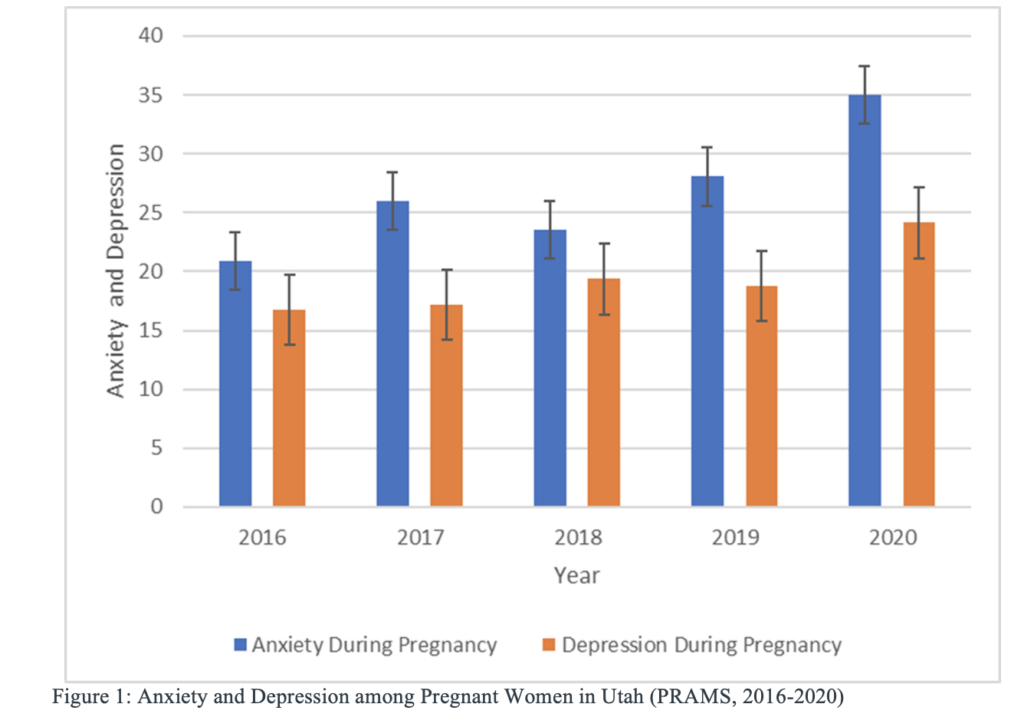
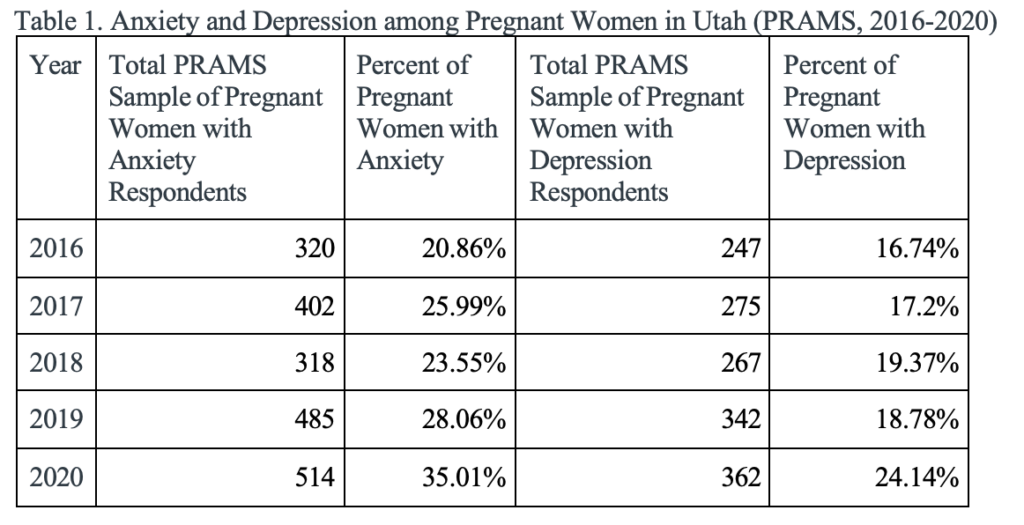
Depression and anxiety rates among pregnant women in Utah rose notably between 2016 and 2020 (Table 1 and Figure 1). Rates of anxiety during pregnancy had an absolute increase of more than 14 percent (20.9% to 35.0%), and depression increased by more than 7 percent (16.7% to 24.1%) during this period. The confidence intervals for rates of both anxiety and depression do not overlap between 2019 and 2020. This increase has a devastating impact on the emotional and physical health of mothers and their children. While it is immediately unclear why rates of anxiety and depression during pregnancy were rising between 2016 and 2020, the COVID-19 pandemic could partially explain the increases in more recent years, from 2019 to 2020 (7.0% absolute increase in anxiety, and 5.4% absolute increase in depression). In a study with Canadian women conducted for the same time period, increased anxiety and depression were observed during pregnancy compared to pre-pandemic pregnancy cohorts. Several reasons were cited for this increase related to the pandemic, including social isolation, relationship stress, less access to prenatal care, and concern about the threat of COVID-19 to the health of the mother and baby.8

Conclusion

Rates of anxiety and depression among pregnant women in Utah have been increasing since 2016. This is in line with findings from other US states of pregnant women who have shown a more pronounced increase in anxiety and depression during the pandemic compared to before the pandemic 1 Anxiety and depression during pregnancy not only negatively affect the emotional and physical health of the mother, but also can negatively impact the health of the baby. It is fair to speculate that increased rates of depression and anxiety also cause an increase in the adverse health outcomes discussed above, such as rates of preeclampsia, premature membrane rupture, preterm delivery, cesarean section, intrauterine fetal death, intrauterine fetal growth restriction, and lower cognitive development of the infant.

There are a few recent studies that have addressed what factors may help decrease the risk of anxiety and depression during pregnancy, specific to the context of the COVID-19 pandemic. Lebel, et al., found that increased social support and increased exercise were protective factors.8 Similarly, Khourry, et al., found that social support was associated with lower amounts of mental health problems during pregnancy.10 More research is needed, however, on why anxiety and depression during pregnancy may be increasing and what pregnant women and their healthcare providers can do to help reduce the risk of experiencing them in addition to resources currently available. Healthcare providers should screen for anxiety and depression at least one time during pregnancy. Treatments are available, including psychotherapy or antidepressants.9 UDOH offers a Maternal Mental Health Referral Network, which allows individuals to search for mental health providers throughout Utah by county, provider type, insurance, and specialty.11 The University of Utah also has a dedicated webpage with information about mental health problems during and after pregnancy and maternal mental health services .12 The Utah Women and Newborns Quality Collaborative works with providers statewide to make recommendations on education, screening, detection, and response protocols.13 Other resources are available, such as the Emily Effect, which allows individuals to share their stories relating to mental health during and after pregnancy.14 Regardless of their experience during pregnancy, pregnant women with mental health concerns should not hesitate to reach out to their healthcare providers.

Acknowledgements

Data were provided by the UT-PRAMS, a project of the UDOH, the Office of Vital Records and Health Statistics of the UDOH, and the CDC of the US Health and Human Services Department. This report does not represent the official views of the CDC or UDOH.

References

  1. López-Morales H, Del Valle MV, Canet-Juric L, et al. Mental health of pregnant women during the COVID-19 pandemic: A longitudinal study. Psychiatry Res. 2021;295:113567. doi:10.1016/j.psychres.2020.113567
  2. Alfayumi-Zeadna S, Bina R, Levy D, Merzbach R, Zeadna A. Elevated perinatal depression during the COVID-19 pandemic: A national study among Jewish and Arab Women in Israel. J Clin Med. 2022 Jan 11;11(2):349. doi: 10.3390/jcm11020349. PMID: 35054043; PMCID: PMC8778708.
  3. Lahti-Pulkkinen M, Girchenko P, Robinson R, et al. Maternal depression and inflammation during pregnancy. Psychol Med. 2020;50(11):1839-1851. doi:10.1017/S0033291719001909
  4. Rudolph MD, Graham AM, Feczko E, et al. Maternal IL-6 during pregnancy can be estimated from newborn brain connectivity and predicts future working memory in offspring. Nat Neurosci. 2018;21(5):765-772. doi:10.1038/s41593-018-0128-y
  5. Khanghah AG, Khalesi ZB, Hassanzadeh Afagh R. The importance of depression during pregnancy. JBRA Assist Reprod. 2020;24(4):405-410. doi:10.5935/1518-0557.20200010
  6. Urizar GG, Muñoz RF. Role of maternal depression on child development: A prospective analysis from pregnancy to early childhood. Child Psychiatry Hum Dev. Published online March 1, 2021. doi:10.1007/s10578-021-01138-1
  7. Utah PRAMS. Maternal and Infant Health Program. Accessed March 22, 2022. https://mihp.utah.gov/pregnancy-and-risk-assessment. Includes IBIS-PH – Pregnancy Risk Assessment Monitoring System (PRAMS) Query Module. Public Health Indicator Based Information System (IBIS). Accessed April 1, 2022. https://ibis.health.utah.gov/ibisph-view/query/selection/prams/PRAMSSelection.html
  8. Lebel C, MacKinnon A, Bagshawe M, Tomfohr-Madsen L, Giesbrecht G. Elevated depression and anxiety symptoms among pregnant individuals during the COVID-19 pandemic. J Affect Disord. 2020;277:5-13. doi:10.1016/j.jad.2020.07.126
  9. Mayo Clinic Staff. Depression during pregnancy: You’re not alone. Mayo Clinic. Published January 25, 2022. Accessed March 22, 2022. https://www.mayoclinic.org/healthy- lifestyle/pregnancy-week-by-week/in-depth/depression-during-pregnancy/art-20237875
  10. Khoury JE, Atkinson L, Bennett T, Jack SM, Gonzalez A. COVID-19 and mental health during pregnancy: The importance of cognitive appraisal and social support. J Affect Disord. 2021;282:1161-1169. doi:10.1016/j.jad.2021.01.027
  11. Maternal Mental Health Provider Network. MHRN. Accessed March 22, 2022. https://maternalmentalhealth.utah.gov/
  12. Maternal Mental Health Services. Huntsman Mental Health Institute. Accessed March 22, 2022. https://healthcare.utah.edu/hmhi/treatments/maternal-mental-health/index.php
  13. UWNQC. Maternal and Infant Health Program. Accessed March 22, 2022. https://mihp.utah.gov/uwnqc/maternal-mental-health
  14. The Emily Effect. Accessed March 22, 2022. https://theemilyeffect.org/

Citation

Valcarce K, Myrer R, and Garces J. (2022). Comparison of Anxiety and Depression among Women Who Gave Birth in Utah 2016-2020 Using the Pregnancy Risk Assessment Monitory System (PRAMS). Utah Women’s Health Review. doi: 10.26054/0d-46dz-sr1a

PDF

View / download